
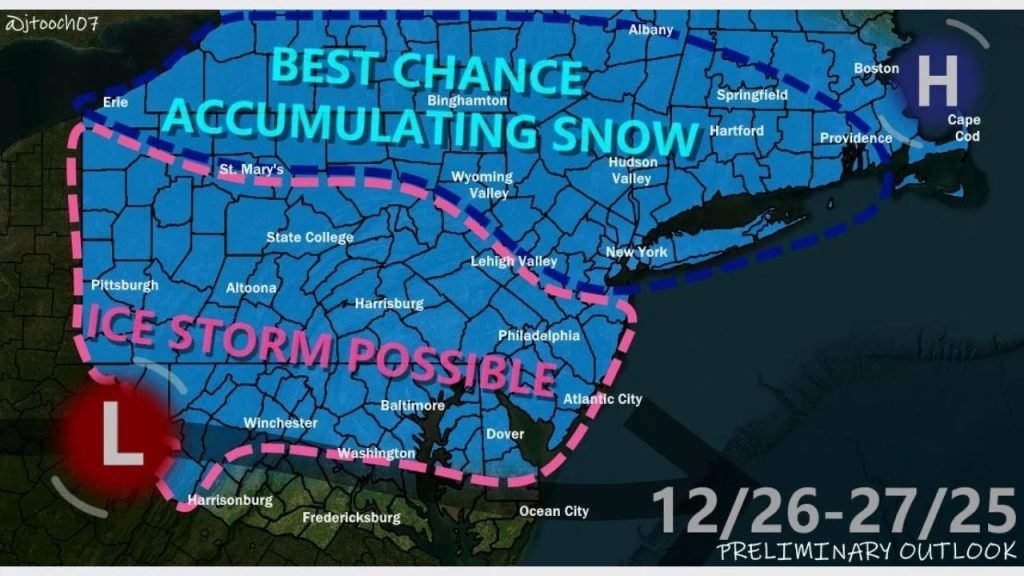
A growing winter weather system is causing concern in the Northeast and Mid-Atlantic United States, as forecast data indicates a more powerful clipper storm capable of dumping snow, sleet, and pockets of ice from Friday to early Saturday, December 26-27.
While a weaker clipper will pass through the region ahead of this system, meteorologists believe Friday’s setup has a bigger impact potential, particularly in inland and northern areas where colder air is more firmly in place.
Best Chance for Accumulating Snow in Northern and Interior Zones
This Article Includes
The most likely areas for snow accumulation, according to forecasts, include central and northern Pennsylvania, upstate New York, interior New England, and mountainous terrain in the Northeast.
These places are on the colder edge of the system, with temperatures forecast to hover around or below freezing for much of the event, allowing snow to pile more efficiently. Snowfall potential increases north and west of major metropolitan areas when colder air remains trapped for longer.
Ice Storm Risk Increases Across the Mid-Atlantic Interior
Further south and west, forecast models predict a significant ice storm risk in southern Pennsylvania, northern Maryland, and inland regions of the Mid-Atlantic.
In certain places, a warm layer aloft mixed with sub-freezing surface temperatures may promote freezing rain or sleet, especially overnight and early in the morning. Even little ice accumulations can provide hazardous traffic conditions, particularly on untreated roadways and elevated surfaces.
Major Cities Face Mixed Impacts and Travel Disruptions
Urban corridors from Philadelphia northward through New York City and into southern New England are expected to receive mixed precipitation, with snowfall turning to sleet or rain depending on timing and temperature.
Forecast projections suggest:
- Under 1 inch of snow near Philadelphia
- 1 to 3 inches closer to New York City and Boston
- Higher totals north and west of these cities
While totals may be low in city centers, slushy buildup and brief ice could hinder morning and evening travel, especially along heavily frequented routes like Interstate 95.
Temperature Contrast Drives Sharp Impact Differences
One of the distinguishing features of this system is the tight temperature gradient across the region:
- Above-freezing conditions are expected across parts of central Maryland and coastal zones
- Near-freezing temperatures persist across southern Pennsylvania
- Below-freezing air dominates the Poconos, Lehigh Valley, interior New York, and New England
This contrast allows for fast changes in precipitation type, resulting in highly varying localized impacts over short distances.
Forecast Confidence Still Evolving
Meteorologists advise that this is only a preliminary forecast, with the exact storm course, thermal profiles, and precipitation amounts all susceptible to change. Small changes in the system’s route could substantially modify where snow, ice, or rain fall.
Residents in the impacted areas are encouraged to keep an eye on revised predictions, particularly those planning holiday travel or early morning commutes between December 26 and 27.