
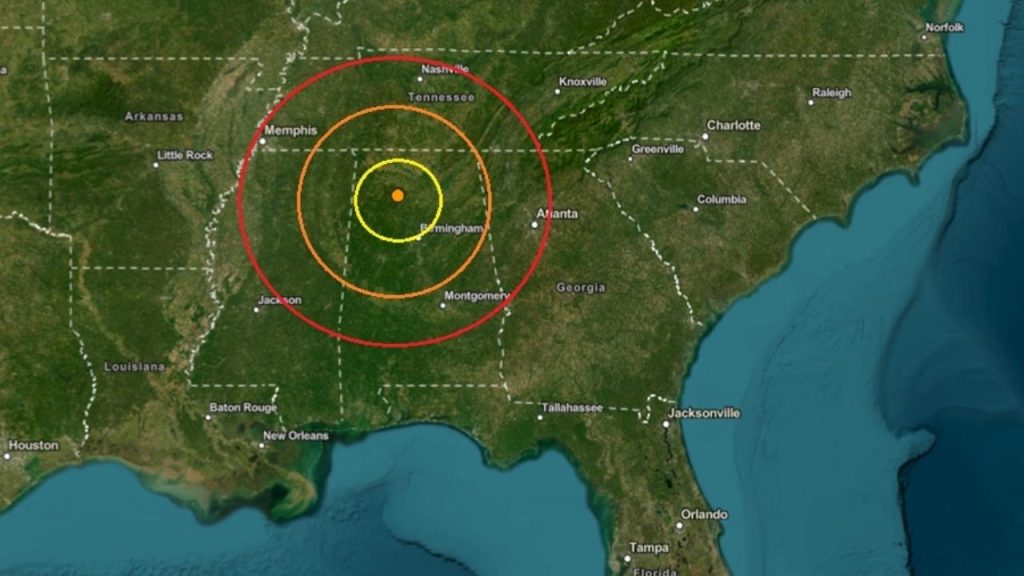
According to the USGS, two earthquakes hit Alabama last night, roughly north and west of Birmingham. The first earthquake struck near Addison at 9:17 p.m. from a depth of 16.2 kilometers; it was rated as a magnitude 2.4 event. The second earthquake occurred about 40 minutes later, at 9:59 p.m., around 4,000 feet north and east of the first, at a depth of 14.8 km; it was assessed as a slightly lesser magnitude 2.3 event. There were no reports of damage or injuries from either earthquake.
According to the USGS, earthquakes with a magnitude of 2.0 or less are rarely felt or heard by individuals; nevertheless, as the magnitude increases, more and more people can feel them. While damage is likely with magnitude 3.0 or higher shocks, serious damage and casualties are rare until a seismic event’s magnitude increases to 5.5 or above.
According to the Geological Survey of Alabama (GSA), earthquakes are fairly common in the state. According to GSA, “The majority of the earthquakes we experience in Alabama are associated with the Southern Appalachian Seismic Zone (an extension of the East Tennessee Seismic Zone) that runs along the Appalachian Mountains from the northeastern corner into the central part of the state and the Bahamas Fracture Seismic Zone in southern Alabama.
In 1916, a magnitude 5.1 earthquake struck northern Shelby County, making it the state’s biggest ever.
The second and third biggest earthquakes were both classified as magnitude 4.9 events. On April 29, 2003, one struck in DeKalb County, about ten miles northeast of Fort Payne. The earthquake was felt throughout the northern half of Alabama and Georgia, much of Tennessee, and even parts of Kentucky, North and South Carolina, and Mississippi. The other earthquake occurred in Escambia County on October 24, 1997, and caused a berm around a lake to disintegrate, sending water and fish across a road. Large fissures appeared in the sand by a brook not far from the epicenter. Both 4.9 magnitude events caused some damage, primarily to weaker masonry in the state’s northern regions.