
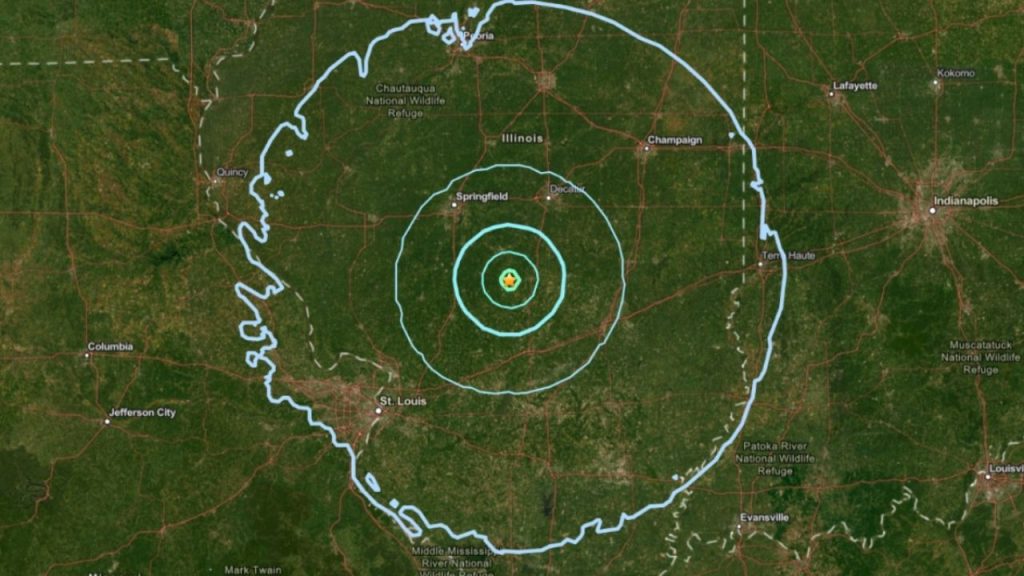
A magnitude 3.5 earthquake struck southern Illinois in the early hours of Tuesday morning, according to the U.S. Geological Survey (USGS), a tremor felt in neighboring St. Louis, Missouri.
According to the USGS, the epicenter was around 2.5 miles east of Ohlman, Illinois, and the quake had a depth of roughly 5.5 miles. Over 1,000 people reported experiencing the tremor to the USGS.
The earthquake severely affected not only St. Louis and both sides of the Illinois-Missouri border, but also Springfield, Decatur, Effingham, and Greenville.
“This large region borders the much more seismically active New Madrid seismic zone on the seismic zone’s north and west,” says the USGS.
“The Illinois basin-Ozark dome region covers parts of Indiana, Kentucky, Illinois, Missouri, and Arkansas and stretches from Indianapolis and St. Louis to Memphis.
“Moderately frequent earthquakes occur at irregular intervals throughout the region.”
These earthquakes in the central and eastern U.S. are “less frequent than in the western U.S.” but are “typically felt over a much broader region,” the USGS says.
The region’s largest earthquake struck in 1968, with a magnitude of 5.4, causing damage throughout southern Illinois.
Earthquakes of a devastating magnitude occur in the region every one to two decades, with minor tremors occurring a few times every year.
California Earthquake Sparks Emergency Alerts
The USGS reported a magnitude 4.9 earthquake in Southern California on Monday evening, located around 12 miles north-northeast of Indio.
The Coachella Valley and nearby locations felt the tremor shortly before 6 p.m. local time.
The temblor was felt throughout Southern California, causing fear among millions of citizens.
As of 7 p.m. local time, four aftershocks of magnitude 3.0 or higher had been registered in the Indio area, with the highest reaching 3.5 magnitude, according to USGS data.
The USGS initially reported the earthquake’s magnitude as 5.1, then lowered it to 4.6 before settling on 4.9.
This change emphasizes the complexities of real-time seismic data processing during intense earthquake events.
Millions of people in the region received emergency alerts on their phones seconds before the earthquake struck, according to Patch.
The signals, which are part of California’s early warning system, indicated that the quake was 5.1 magnitude, which was previously estimated to be 5.1 by the USGS.
According to the Southern California Seismic Network, more aftershocks are predicted in the coming days, with the greatest estimated to be one magnitude unit smaller than the mainshock.
However, seismologists acknowledged a slight chance—approximately 5%—that a stronger earthquake could occur, though this possibility reduces over time.