
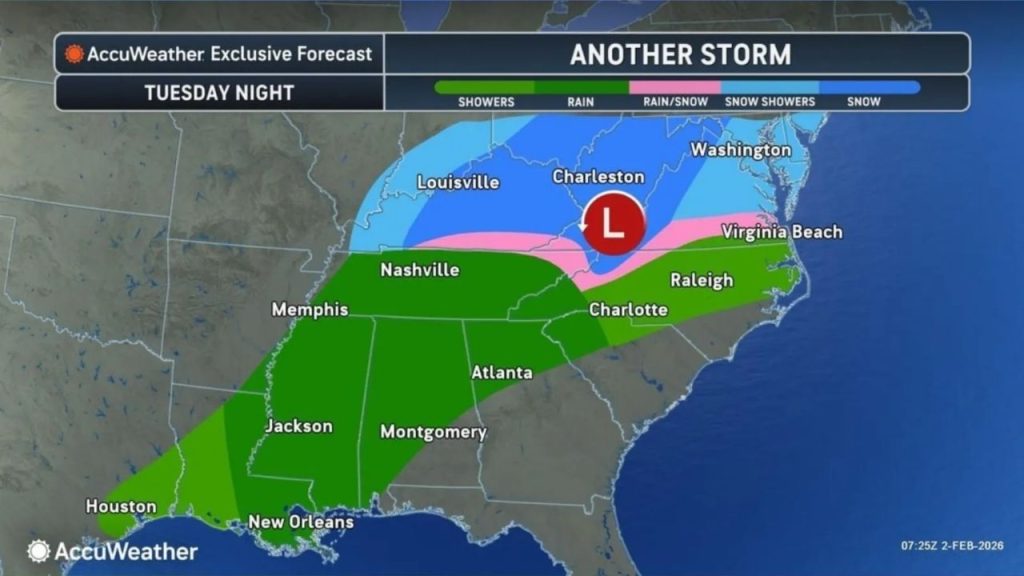
A midweek system is expected to bring snow to numerous states in the Ohio Valley and Mid-Atlantic, AccuWeather analysts warned in a media advisory shared with Newsweek on Tuesday.
“While snowfall amounts are expected to be lower than recent storms, lingering cold will allow even modest snow and refreezing to disrupt travel and operations,” the advisory said.
According to AccuWeather, the system is expected to enter western Tennessee on Tuesday before moving eastward and arriving near the Virginia coast on Wednesday. It is forecast to travel fast and avoid strong intensification, resulting in snowfall levels below those observed in late January.
According to AccuWeather, up to an inch of rain might fall from late Tuesday night into Wednesday morning in Baltimore and Washington, D.C.
“Cities like Washington, D.C., or Baltimore could see upwards of an inch late Tuesday night into Wednesday morning, and even a stripe of snow that tries to make it to the Eastern Shore of Maryland,” AccuWeather meteorologist Tyler Roys said.
Meteorologist David Roth of the Weather Prediction Center told Newsweek that ice and snow are still present over most of the country, including places that have recently experienced severe winter weather. “This will intersect some of that storm’s pattern,” Roth told reporters.
Fox Weather also warned that a “stronger clipper” is anticipated to traverse the Great Lakes and Northeast late Thursday, perhaps bringing 1-3 inches of snow to these locations, with higher elevations receiving more.
“Forecast details will continue to be refined as the event draws closer,” said the Fox Forecast Center on Monday.
The latest forecasts follow a bomb cyclone that caused weather warnings in several states and dumped more than a foot of snow on North Carolina over the weekend.
A bomb cyclone, also known as bombogenesis, can form when cold and warm air clash, such as air above warm ocean waves. According to the National Oceanic and Atmospheric Administration, it can also happen when a cyclone rapidly strengthens over the course of a day.