
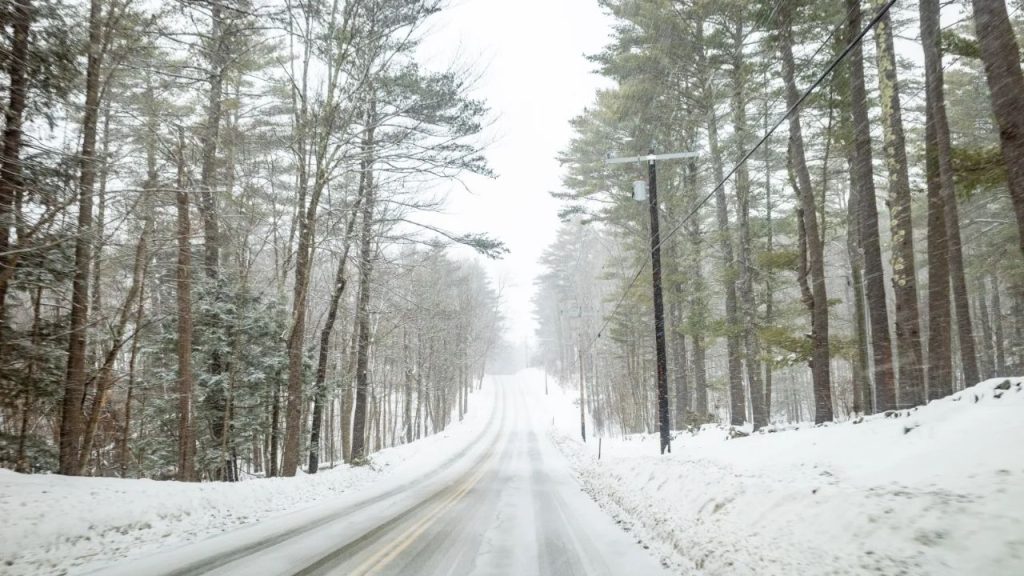
National Weather Service (NWS) meteorologists are warning of heavy snow across the Northeast on Tuesday, with new advisories expanding to include more states as a winter storm threatens travel and daily life.
Winter weather advisories are in force for New York, Vermont, New Hampshire, and nearby counties due to a fast-moving cyclone causing snow accumulation and hazardous driving conditions. As snowfall intensifies, the NWS predicts that the effects will last until early Wednesday. Meteorologists issued the first batch of winter weather advisories on Monday, which were expanded to encompass additional states overnight.
As of Tuesday morning, New York, Connecticut, Massachusetts, Vermont, New Hampshire, Pennsylvania, and Maine were under winter weather advisories warning of severe snowfall.
New Hampshire has the broadest advisory, with the whole state under some type of winter weather warning. NWS meteorologist Derek Schroeter, who works at the Gray, Maine, office that makes New Hampshire forecasts, told Newsweek that the worst of the snow would fall Tuesday evening and should be gone by Wednesday morning. Snow will take longer to melt farther north and east in Maine, as well as in higher-elevation locations.
“A weak weather system will bring a period of light snowfall to the region. Although snowfall amounts will be light, travel will still be impacted due to snowfall accumulations on untreated roads,” NWS Gray, Maine, said in a winter weather advisory. “Periods of moderate and heavy snow will combine with low visibility to create dangerous driving conditions. The hazardous conditions could impact the Wednesday morning commute.”
Which States Are Impacted By Heavy Snow?
This Article Includes
New York, Connecticut, Massachusetts, Vermont, New Hampshire, Pennsylvania, and Maine are all expecting snow on Tuesday or Wednesday, depending on where they are.
The winter weather advisory area includes cities such as Boston; Burlington, Vermont; Portland, Maine; Manchester, New Hampshire; Hartford, Connecticut; Syracuse, New York; and Binghamton, New York.
How Much Snow Will Fall?
Snowfall quantities can range from 1 to 7 inches. The heaviest snowfall is expected in northern Fulton and southern Herkimer counties in New York, as well as Bennington and western Windham counties in Vermont, with up to 7 inches forecast. Some locations, such as parts of New York, Connecticut, and Massachusetts, may receive little to no precipitation, but whatever snow does fall will be accompanied by a layer of ice, creating especially hazardous travel conditions.
“Plan on slippery road conditions. The hazardous conditions could impact the Tuesday evening and Wednesday morning commutes,” NWS Boston, Massachusetts, said in a winter weather advisory.
When Will Snow Arrive?
In most cases, snow will start falling early Tuesday afternoon.
Snowfall starts at different times in New York. Snow might start falling in Northern New York as early as 10 a.m. The primary hazard to southern New York and northeastern Pennsylvania will be freezing rain, which will begin to fall around 3 p.m. Tuesday.
“While a few snow showers will move through in the morning the precipitation will transition to freezing rain in spots and last through the evening hours,” NWS Binghamton, New York, said.
In Snow will fall in Connecticut and Massachusetts, according to NWS Boston meteorologists, beginning at 6 p.m. local time Tuesday and continuing until 6 a.m. Wednesday.
Snow will fall earlier in Vermont, about 2 p.m. local time Tuesday, and will last until 7 a.m. Wednesday.
“The heaviest snowfall rates are expected to occur during the evening commute and will likely yield slow travel during this time,” NWS Burlington, Vermont, said in a winter weather advisory. “Roads will likely become slick and hazardous. Plan on slippery road conditions.”
Snowfall will begin in Maine and New Hampshire around 5 p.m. on Tuesday.
Will School Be Closed On Wednesday?
It is unclear whether schools in the affected areas would remain open, operate on a delayed timetable, or close due to risky travel circumstances. It is dependent on the precise time and location of the snowfall. In certain cases, Schroeter told Newsweek that road crews should have plenty of time to clean roads before Wednesday bus routes begin, but in others, snow may continue to pile until Wednesday morning.
People in the affected areas are asked to follow local meteorologists’ advice and keep an eye out for updates from school officials.